
The kit list · 52 of 152 rated so far
What I carried
Everything that went on the bike, what it cost, and whether it earned its place. Three apps at the bottom that mattered as much as any of it. No affiliate links, nothing sent to me for free.
- Kept
- 45
- Ditched
- 3
- Replaced or changed
- 3
- Rated so far, USD
- 17'829
How big a bike
750–800cc is the ceiling I would set for going alone.
Outside Argentina and Chile you barely see anything above 1000cc. A big bike sticks out like a sore thumb, in places where standing out is not what you want. And because the size is rarer, parts and replacements are not sitting on a shelf when you need them.
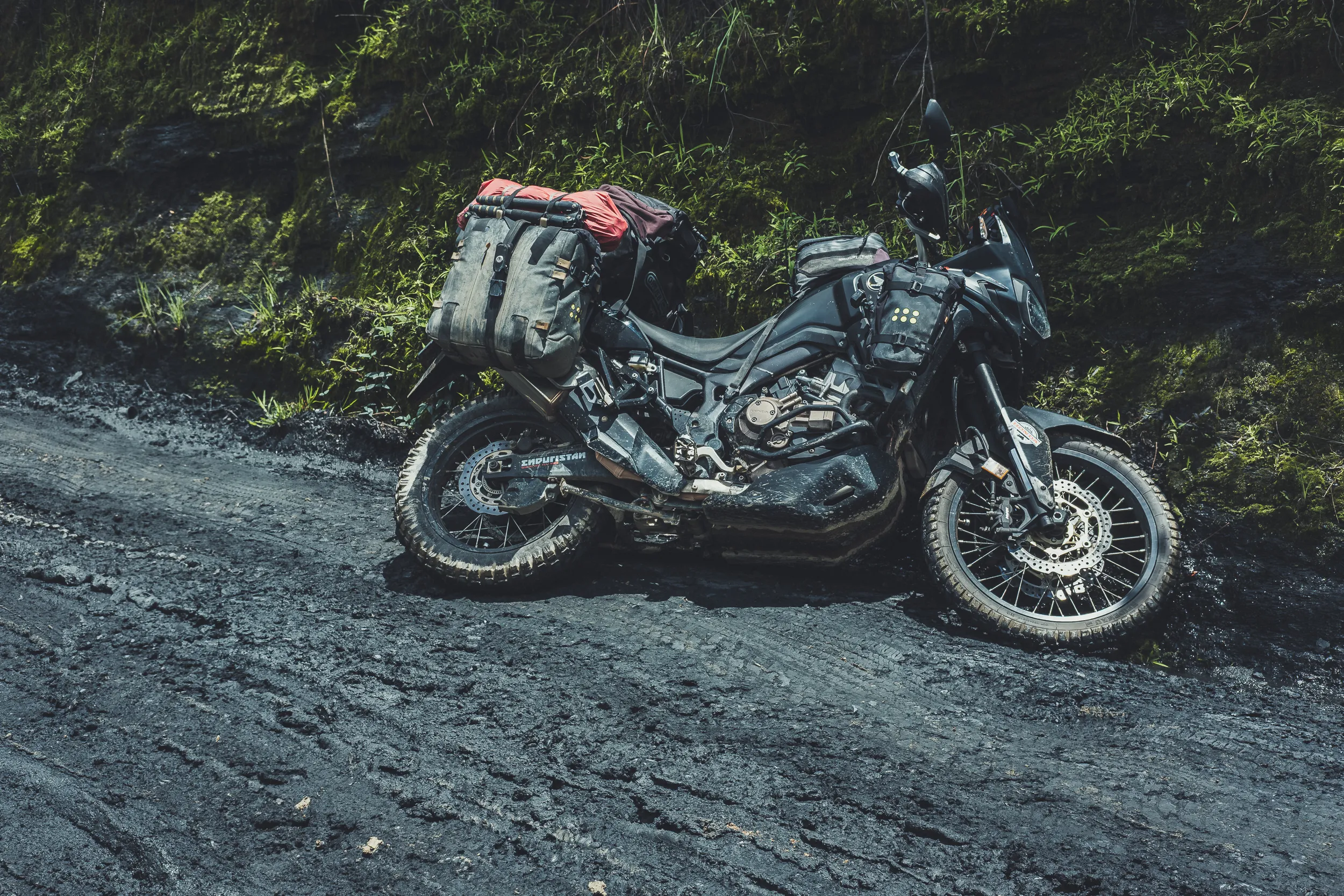
Then there is the weight. Overlanding solo on a 230 kg loaded setup brings its own set of problems, and most of them arrive at the moment the bike goes over. You are picking it up alone, on gravel, at altitude, in the rain, with everything still strapped to it.
BMW GS riders have an accidental advantage here. The boxer cylinders stick out far enough that the bike never lies all the way down, so there is less lean angle to fight and less to lift.
Where a big engine genuinely earns its place is busy highway and overtaking long lines of trucks. You get plenty of both on the Panamericana. But neither of those is where I wanted to spend my time.
So: smaller is better. I rode 57,000 km on a 1000cc bike and enjoyed it, and I would still tell you to buy less bike than that.
How I chose any of it
Three months of preparation at home, and too much of that was spent overthinking. I got sucked into forums where people with very different ideas of overlanding are extremely specific about the only correct way to do it. What I came out with was three rules.
- 01
Blend in
No loud gear, nothing that looks expensive, no colourful prints on the bike. Mine started life as a red CRF1000 and I wrapped the tank and fairings in matt black 3M. The riding gear followed the same logic — I did not want to stand out, least of all when photographing people.
- 02
Buy it before you go
I compared Swiss prices against South America before leaving, and the assumption that gear is cheaper down there is wrong. Most of it costs more, so buying at home saved 20 to 30 per cent. What is genuinely cheaper on the road is everyday living: food, a bed, fuel. Not the equipment you would order online or pick up from a dealer.
- 03
You will finish with less than you started
Apart from a warmer sleeping bag, tyres, and a replacement camera after mine was stolen — 20 per cent dearer in Chile than it would have been at home — I bought almost nothing while travelling. The jerry can I gave away halfway. Plan for subtraction, not addition.
The preparation saved real money, for the kind of travelling I wanted to do. What actually helped was following people who travelled the way I wanted to travel, and taking their advice, rather than spending time in forums.
On the bike
- Honda CRF1000L Africa Twin, DCT 11'954 Kept
DCT wasn't my first choice but worth it. Had a blast. For long distances, and for taking pictures while riding, I would have loved cruise control — though the more gimmicks a bike has, the more there is to fail.
- Disc lock 96 Kept
Activated on movement, so it doubled as a luggage alarm when I was asleep in the tent on campgrounds. Definitely saved me once.
- Heidenau K60 Scout tyres 192 Kept
Great range and trusty in all situations. Readily available across the Americas, long lasting, and good off-road. Probably everything has already been said about them.
- Touratech Rallye bash plate 368 Kept
Plenty of deep scratches. No doubt this saved the bike, and it adds a lot of confidence in rough terrain.
- Touratech crash bars 185 Kept
Paired with the Rallye plate, I stopped worrying about crashing. Like the plate, it has plenty of stories to tell.
- Barkbusters JET handguards 160 Kept
A must. Saved my hands a couple of times.
- Pivot Pegz PP-062 MK3 171 Kept
Huge upgrade from the stock pegs.
- 2× Kriega OS-32 soft panniers 507 Kept
All the Kriega bags delivered. After all the discussion about hard versus soft cases, there is no doubt these were the right choice for overlanding. In the city, sure, not as safe.
- 2× Kriega OS platform 128 Kept
Same as the OS-32, and held all the cooking equipment.
- 2× Steelcore security strap 69 Kept
Plenty safe for locking the bags outside the tent at night, at a petrol station, or while buying groceries.
- SW-Motech EVO pannier rack — Kept
Sturdy and reliable.
- SW-Motech pillion seat rack 176 Kept
Sturdy, looks great, and plenty of holes to attach straps to.
- Fork seal savers 19 Kept
To this day the fork tubes look like new, thanks to this little item.
- Touratech screen, small, tinted 170 Kept
Fine off-road, but I added a small bolt-on shield for highway days.
- Tool roll 27 Kept
Kept everything rattle-free and neatly organised.
- USB adapter 18 Kept
The one source of power on the road.
- Standard-height seat 213 Kept
- Bar risers, 20 mm 62 Kept
- Fender extender 75 Kept
- Brake fluid reservoir guard 37 Kept
- Chain guard fin 49 Kept
- Chain guard extension 59 Kept
- Heated grips — Kept
Came fitted. If it had not, I would have added them. Riding around Patagonia at five degrees in three-season gloves was worth more than most of the things on this list.
- Michelin ultra heavy-duty tubes — Kept
35,000 km without a single flat. That ended when a car tyre weight went straight through the rear wheel on California’s Route One.
- Bike cover 16 Ditched
Riding gear
- Touratech Aventuro Carbon helmet 553 Kept
Light, comfortable, and held up until the end.
- Rev'It Sand Urban jacket 459 Kept
Safe, comfortable, super tough and low key.
- Aether Range trousers 427 Kept
Great on and off the bike, and low key.
- Sidi Adventure 2 boots 160 Kept
These went through everything and held up in any condition. Also against dog bites. Worth the money.
- Garmin inReach Explorer 320 Kept
Gave me great confidence on a solo trip. One button away from an SOS, and a reliable map. To me a must.
- Garmin powered mount 42 Kept
Plugged into the bike's USB, the Explorer was always at 100% and in sight.
- Body protector, 3DF AirFit Lite 267 Kept
Breathable, comfortable, and absorbs well off-road.
- Sand 3 gloves 85 Kept
Daily gloves. I still use them. Great quality.
- Waterproof gloves — Kept
A second pair for cold and rainy days. Definitely a keeper.
- Kriega Hydropak 3L 32 Kept
Carried on my back every day and kept me hydrated on long stretches. At altitude especially, I drank far more often than I would have from bottles.
- Hi-vis vest — Kept
For highway sections and riding at night.
- Aventuro tinted visor 52 Ditched
A second visor to carry around was cumbersome. In the end I used the clear visor with sunglasses.
Camping and kit
- Helinox Zero camping chair 90 Kept
I thought this was a luxury. It is not. Bring a chair. After a long day on the road it makes a big difference to sit comfortably by the fire.
- Ortlieb 60L duffle 149 Kept
Great quality, impressive zips. All my clothes, and anything that had to come into the tent.
- MSR Dromedary water bag 32 Kept
One for petrol and one for water. Highly reliable, recommended. Tank range is a favourite argument among overlanders; the honest answer is that I dipped into the spare fuel twice in nine months. A soft bladder is the only extra fuel I would carry again — it packs flat when it is empty.
- 1 gallon jerry can — Ditched
Carried to cover the 350 km average range. Overkill. I gave it away halfway through the trip and never wanted it back.
- Sea to Summit pillow — Kept
Light, small, and worth it. Good for rest days.
- Microfibre towel 26 Kept
Any microfibre towel will do. Big space saver.
- Petzl head torch — Kept
Doubled as the camping light inside the tent. Rechargeable from the bike's USB.
- Sea to Summit Spark sleeping bag 299 Replaced on the road
Super light summer bag. I went for weight, which was a mistake. Replaced after the first few nights.
- Thermolite Reactor Extreme liner 75 Replaced on the road
I thought this plus the summer bag would be enough for moderate to low temperatures. Traded both for a much thicker sleeping bag.
- Sea to Summit mosquito head net 11 Never used
As much as I hate mosquitos, the net was not the answer. Keep them out of the tent, spray, or gain altitude.
Cameras
- Fujifilm X-T2 — Kept
Photography was a major part of the journey, so I wanted something powerful and compact. I sold my Nikon gear and put the money into lenses instead. Twenty-four megapixels is plenty, and it keeps the workflow fast on the road, which higher-resolution systems do not.
- Fujinon 16mm f2.8, 35mm f1.4, 90mm f2.0 — Kept
Three primes, no zoom. I alternate between the bike, the landscape and people, and these cover all three.
- f-stop ICU insert — Kept
Holds the whole camera kit and drops into the tank bag.
- Enduristan Sandstorm 4H tank bag — Kept
Quick access to the camera while riding, and the whole bag comes off the bike in seconds when I stop.
- DJI Mavic Pro — Would change
The gimbal is fragile. I replaced the gimbal cable four times over the trip, which for a piece of kit that only comes out occasionally is a poor return.
On the phone
Three apps, and that is the whole list. All three have changed since 2018, so each one says what it costs now and what happened to it.
-
iOverlander
Where to sleep Free, with optional paid tiersThe single best source for finding somewhere to sleep or put up a tent. Overlanding-specific points of interest, and plenty of good tips from people who were there first.
SinceRebuilt as iOverlander 2 and now run on a nonprofit model with optional subscriptions. The free tier still works, but it carries ads and limits how much you can download at once. The web version at ioverlander.com is still fully free.
-
maps.me
Offline maps Free at the timePaired with iOverlander this was the daily setup. iOverlander to find the place, maps.me to get there, and neither one needing a signal.
SinceSold in 2020, taken closed-source, and pushed hard into ads and upsells. The original developers forked the last open version as Organic Maps, which is free, ad-free and built on the same OpenStreetMap data. If you are setting this up today, install Organic Maps instead.
-
Trail Wallet
Logging what you spend Free to 25 entries, then about USD 5 onceTakes a couple of seconds to log everything you spend, so you stay in control of the budget and worry less on the days you have to spend extra because you got bogged down.
SinceStill works, still a one-off payment rather than a subscription, but no longer actively maintained — the last update was in 2019 and the developer says support is limited. Worth knowing before you commit a year of data to it.
Every figure on the costs page came out of this
ADVroad went through the full build in an interview from September 2018, including the bits this page skims over. Gear prices are what I paid in Switzerland in 2017, before the trip. App prices were checked in 2026. The remaining 100 items — tools, spares, the medical kit and the paperwork — are still being written up.